
The week the Republican establishment blew a 22-point lead. Sen. Bill Cassidy finished third in his own Louisiana primary; Trump-endorsed challengers swept primary night (Barr in, Massie out); Georgia spilled into June runoffs; and DOJ stood up a $1.776B ‘Anti-Weaponization Fund’ that even Republicans are calling a slush fund. NBA Eastern Conference Finals as the lens.

- Sen. Bill Cassidy (R-LA) finished THIRD in his own primary Saturday, May 16 — 24.8%, behind Trump-endorsed Rep. Julia Letlow (44.8%) and former Rep./state treasurer John Fleming (28.3%). First sitting U.S. Senator to place worse than second in a renomination primary since Hattie Caraway in 1944; first to lose renomination outright since Lugar in 2012. Cassidy voted to convict Trump in 2021. Letlow–Fleming runoff is June 27.
- Trump ran the table on primary night, Tuesday May 19. Rep. Andy Barr won the KY Senate GOP primary with 60.5% over Daniel Cameron for McConnell’s open seat (faces Democrat Charles Booker in November). In KY-04, Trump-endorsed Navy veteran Ed Gallrein knocked off Rep. Thomas Massie, targeted over the Epstein-files fight.
- The $1.776 billion “Anti-Weaponization Fund” is the biggest story in Washington — and is drawing bipartisan Republican alarm. DOJ is funding it out of the permanent Judgment Fund as part of the settlement of Trump’s $10B suit against the IRS. Moran questions the “legality.” Cassidy sees “no legal precedent.” Tillis: “stupid on stilts.” Two lawsuits filed Friday; the D.C. case drew Judge Richard Leon.
- Georgia is a mess. GOP Senate primary heads to a June 16 runoff between Rep. Mike Collins (under a House Ethics inquiry) and former football coach Derek Dooley (Kemp’s pick) — to face Sen. Jon Ossoff, who has banked $31M. Keisha Lance Bottoms won the Democratic gubernatorial nod; the GOP governor race also went to a runoff.
- Six states voted Tuesday — KY, GA, AL, ID, OR, PA. Tuberville cruised in Alabama (≈85.5%); Brad Little held Idaho (≈59%); Pennsylvania set a Shapiro v. Stacy Garrity governor’s race.
- The slush fund just blew up the ICE/CBP funding bill. The record 76-day DHS shutdown already ended April 30 when Trump signed H.R. 7147 (funding most of DHS — minus ICE and Border Patrol — through May 22). ICE/CBP funding is moving via a ~$72B reconciliation bill that stalled Thursday amid a GOP revolt over the $1.776B fund; the Senate then adjourned for a week’s recess, all but missing Trump’s June 1 deadline. Democrats are loading it with amendments (Van Hollen’s bars payouts to convicted cop-assaulters; others target Jan. 6 assault convicts).
Here is the thing about a 22-point lead with under eight minutes to go. It is not a feeling. It is a number, and the number is enormous. ESPN’s win-probability model had Cleveland north of 99% when its group was up 93–71 in Game 1 on Tuesday. Then Jalen Brunson scored, and stole, and scored, and the Knicks shot 11% from three at halftime and 32% by the end because the only threes that count are the ones that go in late, and Cleveland committed eight turnovers in thirteen minutes, and the building got loud in the specific way the Garden gets loud, and the final was 115–104 New York, in overtime. The biggest playoff comeback in thirteen years. Two nights later the Knicks ran an 18–0 stretch in the third quarter, won 109–93, took a 2–0 lead, and pushed their postseason winning streak to nine. A franchise that has not been to the Finals since 1999 is now two wins from it.
Blowing a 22-point lead is a useful frame for the week the Republican establishment had.
On Saturday, May 16, in Louisiana’s first closed party primary in the modern era, Sen. Bill Cassidy finished third. Not “lost narrowly.” Third, at 24.8%, behind a Trump-endorsed congresswoman and a former congressman, neither of whom cleared 50%, so the two of them now run it back on June 27 while Cassidy goes home. The last sitting United States Senator to place worse than second in a renomination primary did so the year before the atomic bomb. Cassidy’s offense was a vote he cast in February 2021 to convict Donald Trump, and he has spent five years discovering that the lead he thought he had — incumbency, a seat on Finance, a committee gavel — was the basketball version of up 22 with seven to play. Real, and gone.
Three days later, on Tuesday, the model finished its run. In Kentucky, Rep. Andy Barr won the open Senate primary with 60.5% to succeed the retiring Mitch McConnell, after the President’s endorsement and the President’s pressure pushed businessman Nate Morris out of the race entirely. In the 4th District, Trump-endorsed Navy veteran Ed Gallrein beat Rep. Thomas Massie — the libertarian fiscal hawk who has been the single most reliable thorn in leadership’s side on every continuing resolution for a decade, and who crossed Trump one time too many on the Epstein files. In Georgia, the GOP could not even finish the game: the Senate primary and the governor’s primary both spilled into June runoffs while Democrat Jon Ossoff sat on a $31 million war chest and watched.
And underneath all of it — the actual headline, the one even Republican Senators are squinting at — the Department of Justice quietly stood up a $1.776 billion fund to pay people who feel the last administration wronged them, financed out of the one pot of money Congress set aside to pay the government’s lost lawsuits. Up 22. Seven minutes left. Inbound the ball.
Pour something brown. Tip-off.
Xs & Os: The Congressional Card — Eastern Conference Finals
A full playoff slate on the Washington card this week — a Game 1 collapse, a road sweep, an overtime that spilled into June, and an undercard that held serve.
| Pos | Candidate | Notes |
|---|---|---|
| WIN | Julia Letlow (R) | 44.8%, the Trump endorsement, into the June 27 runoff |
| PLACE | John Fleming (R) | 28.3%, the other runoff slot |
| DNP — DNF | Bill Cassidy (R), incumbent | 24.8%, third in his own building. Up 22 in 2020. Lost the lead. |
| HISTORICAL NOTE | Hattie Caraway (D-AR), 1944 | Last sitting Senator to finish this far back. 82-year-old record |
| Field | Detail |
|---|---|
| WIN | Andy Barr (R), 60.5% over Daniel Cameron — open Senate seat, McConnell retiring |
| BENCH | Nate Morris — pressured out before tip by the President |
| UPSET | Ed Gallrein dunks on Rep. Thomas Massie in KY-04; the Freedom Caucus loses its inbounds specialist |
| NOVEMBER | Barr vs. Charles Booker (D), who beat Amy McGrath for the right to run in a safe-R state |
| Field | Detail |
|---|---|
| GOP SENATE | Mike Collins vs. Derek Dooley, runoff June 16, to face Sen. Jon Ossoff (D); Buddy Carter conceded a third-place finish |
| FLAG | Collins under a House Ethics inquiry into alleged misuse of office funds; Carter’s parting shot: “if those two are our candidates, we lose” |
| GOP GOV | Burt Jones vs. Rick Jackson, also to a June 16 runoff |
| DEM GOV | Keisha Lance Bottoms wins the nomination outright |
| MONEY BALL | Ossoff at $31M raised; SMP pledges $20M for him, Senate Leadership Fund $44M against |
| State | Result |
|---|---|
| ALABAMA | Tommy Tuberville wins the GOP governor primary ≈85.5% |
| IDAHO | Gov. Brad Little holds at ≈59% |
| PENNSYLVANIA | Governor’s race set — Josh Shapiro (D) vs. Stacy Garrity (R) |
| OREGON | Down-ballot primaries decided; no marquee statewide upset |
The scoring play of the week: an incumbent United States Senator finishing third in his own primary. In basketball this is called “blowing a 22-point lead.” In politics it is called “the price of one vote, marked in public, five years later.”
| Team | Record | Trend |
|---|---|---|
| Trump-endorsed primary candidates | Near-perfect on the night | Playoff form |
| GOP institutionalists (Cassidy, Massie, Cameron) | 0-for-the-week | Eliminated |
| Senate GOP unity on the slush fund | Cracking (Moran, Cassidy, Tillis) | First real internal friction of the year |
| ICE/CBP $72B reconciliation bill | Stalled Thursday over the slush fund; Senate in recess | June 1 deadline slipping |
| Jon Ossoff | $31M banked, opponents in a runoff | Resting starters |
The Big Five
1. The $1.776 Billion Question: DOJ’s “Anti-Weaponization Fund” Draws Republican Heat
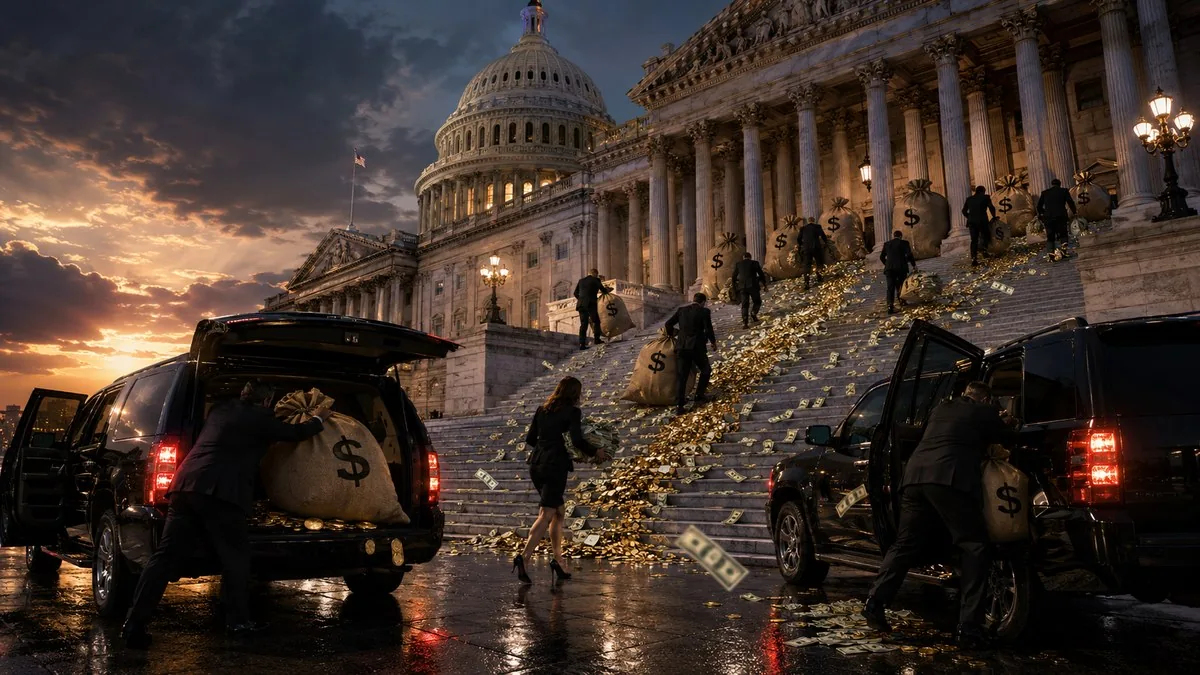
This is the week’s actual story, and it is unusual because the loudest discomfort is coming from the President’s own party.
The Department of Justice has stood up a fund of $1.776 billion — the figure is a deliberate nod to 1776 — to compensate people who claim they were targeted by a “weaponized” federal government under the prior administration. The money traces back to an extraordinary chain of events: in January, Trump and his sons filed a $10 billion lawsuit against the IRS over the leak of his tax returns (the first time a sitting president sued his own administration as a private citizen). DOJ then settled that suit, and the settlement is being financed out of the Judgment Fund — the permanent, indefinite appropriation Congress maintains to pay the government’s lost lawsuits and legal claims.
The fund would be run by five commissioners — four named by the Attorney General, the fifth in consultation with congressional leadership — and the President can remove any of them. They would write the eligibility rules, take claims, and decide who counts as a victim. Acting Attorney General Todd Blanche and the President have defended it as an ordinary settlement. The MAGA universe has already started lining up: MyPillow’s Mike Lindell and former Proud Boys leader Enrique Tarrio are reportedly among the early applicants.
What makes this different from a normal partisan fight is the Republican reaction. Sen. Jerry Moran (R-KS) said he wants to understand the “legality” of creating the fund without Congress. Sen. Bill Cassidy (R-LA) said he sees “no legal precedent.” Retiring Sen. Thom Tillis (R-NC) was characteristically unfiltered: “stupid on stilts,” warning it could end with taxpayers compensating someone who “assaulted a police officer, admitted their guilt, got convicted, got pardoned, and now we’re going to pay them for that.” Even House Budget Chairman Jodey Arrington (R-TX), who defended the concept, conceded it needs “accountability measures and safeguards so that it is not, quote, a slush fund.”
The legislative response is moving on both sides of the aisle. Ranking Member Jamie Raskin introduced the No Taxpayer-Funded Settlement Slush Funds Act; Reps. Brian Fitzpatrick (R-PA) and Tom Suozzi (D-NY) introduced a bipartisan bill barring federal money from paying any claim to the fund; Rep. John Larson has a measure to tax the payouts at 100%. And two lawsuits hit federal court Friday — the D.C. case landing in front of Judge Richard Leon, who has already crossed the President on the ballroom-construction delay and the WilmerHale executive order. And the fight is no longer abstract: this week the fund’s toxicity stalled the GOP’s own $72 billion ICE and Border Patrol funding bill in the Senate (more in §5).
“Stupid on stilts. … It will invariably put us in a position where your taxpayer dollars and my taxpayer dollars could potentially compensate someone who assaulted a police officer, admitted their guilt, got convicted, got pardoned, and now we’re going to pay them for that?” — Sen. Thom Tillis (R-NC), on the Anti-Weaponization Fund
Read past the politics and look at the plumbing. The Judgment Fund is not an abstraction to a federal contractor — it is the backstop that pays you when the government breaches a contract, loses a Contract Disputes Act claim, or eats an adverse Board of Contract Appeals or Court of Federal Claims judgment. It is a permanent appropriation precisely so that a small business that wins a claim against Uncle Sam does not have to wait for Congress to find the money. The precedent being set here — that the Judgment Fund can be tapped for a discretionary, politically administered settlement pool — is the kind of thing that seems remote until the pot is contested, capped, or subjected to new statutory guardrails that sweep in legitimate contract claims as collateral damage. If you have an open CDA claim or a pending appeal, watch the Raskin/Fitzpatrick bills’ definitions closely. The fight over a $1.78B political fund could quietly rewrite the rules of the fund that backstops your receivables.
2. Third in His Own Building: Bill Cassidy’s Historic Collapse in Louisiana

On Saturday, May 16, in the first cycle Louisiana ran under closed party primaries instead of its famous jungle system, two-term Sen. Bill Cassidy finished third in the Republican primary for his own seat. The numbers: Julia Letlow 44.8%, John Fleming 28.3%, Cassidy 24.8%. Because no one cleared 50%, Letlow and Fleming advance to a June 27 runoff. Cassidy advances to private life.
The historical markers are stark. Cassidy is the first elected sitting U.S. Senator to lose renomination since Richard Lugar in 2012, and the first to finish no better than third since Hattie Caraway in 1944. The proximate cause is not mysterious: Cassidy was one of seven Republicans who voted to convict Trump at the 2021 impeachment trial, the only one of them on the ballot this cycle, and — per reporting all spring — the one Republican incumbent Trump’s political operation actively wanted to beat. Trump endorsed Letlow in January. Rep. Clay Higgins, who had flirted with the race, stayed in the House and predicted Cassidy would lose anyway. He did.
Two things matter here beyond the morality play. First, the committee math. Cassidy chairs the Senate Health, Education, Labor and Pensions Committee — the panel that touches OSHA, labor standards, ERISA, and the health-coverage mandates that fall hardest on small employers. A new chair means new priorities for every small business with a payroll. Second, and more durably, the chilling signal. The lesson every Senator just absorbed is that one high-profile vote against the President’s interest can end a career that incumbency, fundraising, and a committee gavel could not save. If you are a contractor counting on oversight — on a Senator being willing to publicly challenge an executive-branch action that hurts your sector — the price of that courage just got marked, in public, in Louisiana. Model your expectations of independent oversight down accordingly.
3. The Sweep: Barr In, Massie Out, and the Trump Endorsement Goes 1.000

Tuesday, May 19, was the cleanest demonstration of the President’s grip on Republican primaries this cycle. Two Kentucky results tell the story.
In the open Senate race to succeed retiring Minority Leader Mitch McConnell, Rep. Andy Barr won the GOP primary with 60.5% over former Attorney General Daniel Cameron — the AP called it at 7 p.m. as the western polls closed. Trump’s endorsement, and Trump’s pressure on businessman Nate Morris to exit, decided it. Barr ran explicitly as an extension of the President’s agenda, touting his vote for the One Big Beautiful Bill Act. He faces Democrat Charles Booker — who beat Amy McGrath for the nomination — in a seat rated safely Republican.
The more telling result was in KY-04, where Trump-endorsed Navy veteran Ed Gallrein unseated Rep. Thomas Massie. Massie is the House’s most committed fiscal libertarian and its most reliable “no” on continuing resolutions, omnibus packages, and leadership-whipped spending deals; Trump targeted him after Massie pushed to force release of the Epstein files. His defeat removes the single most predictable spoiler vote in House appropriations fights.
This is an appropriations story wearing a primary’s clothes. Massie’s “no” votes have repeatedly been the swing that forced leadership to renegotiate spending packages — which means schedule risk, CR risk, and shutdown risk for every contractor waiting on obligated funds. Subtract him from the math and the House majority’s whip count on must-pass spending bills gets more predictable, not less — modestly good news for program stability, if you net out the chaos. On the other side of the ledger, Barr is a senior House Financial Services member; a Barr Senate seat is a friendlier ear on SBA lending, capital access, and community-bank rules that small contractors depend on for working capital. Watch where he lands on committees if he wins in November.
4. Georgia Goes to Overtime: A GOP Senate Runoff, an Ethics Cloud, and a $31M Democrat
The marquee 2026 Senate battleground produced no Republican nominee on Tuesday — just a mess. Rep. Mike Collins and former Tennessee football coach Derek Dooley advance to a June 16 runoff for the right to challenge Democratic Sen. Jon Ossoff. Rep. Buddy Carter, the third major contender, conceded after finishing out of the money — warning on his way out, “if those two are our candidates, we lose.”
The two survivors carry baggage. Collins faces a House Ethics Committee inquiry over allegations he misused congressional funds (paying a former chief of staff for campaign work and employing the aide’s girlfriend, who allegedly did no work). Dooley, son of the legendary UGA coach Vince Dooley, is Gov. Brian Kemp’s pick and runs on “work with President Trump but for you” — but Trump stayed out of the primary and may stay out of the runoff. Meanwhile Ossoff, who ran unopposed, has banked roughly $31 million and is the kind of well-funded incumbent that a bruising, resource-draining GOP runoff is built to help. The governor’s race went to a runoff too: Burt Jones vs. Rick Jackson on the GOP side, with Keisha Lance Bottoms taking the Democratic nomination outright.
Georgia is wall-to-wall defense economy — Fort Moore, Robins AFB, Kings Bay, Hunter Army Airfield, Dobbins — and the Senate seat in play here is one of only two Democratic-held seats up in a state Trump won in 2024. Control of the chamber that confirms every DoD nominee and writes every NDAA mark runs partly through this race. A primary that drags to June 16 (and possibly bleeds money and oxygen all summer) means Georgia’s defense-installation delegation is distracted and the eventual nominee enters the general underfunded against a $31M incumbent. If your business depends on a Georgia installation’s FY27 work, the political instability is now a planning variable, not background noise.
5. The Slush Fund Stalls the ICE Funding Bill — and the June 1 Deadline With It
Here is what makes the $1.776B fund more than a messaging fight: this week it derailed the one must-pass funding vehicle actually moving in the Senate.
A quick realignment of the facts, because they moved fast. The record 76-day DHS shutdown that began February 14 ended April 30, when the President signed H.R. 7147 — funding most of the department (TSA, FEMA, CISA, Coast Guard, Secret Service) through May 22, but pointedly excluding ICE and Customs and Border Protection. Those two agencies have been running on leftover One Big Beautiful Bill Act cash while Republicans move their funding — roughly $72 billion (about $31B for ICE, $23B for CBP, plus related lines) — through budget reconciliation, which needs only 51 votes and bypasses a filibuster.
That bill stalled Thursday. Republicans were sprinting toward a vote when the $1.776B anti-weaponization fund went radioactive inside their own conference. Acting AG Todd Blanche was dispatched to the Hill to calm members; it didn’t hold. Majority Leader John Thune said the White House should have consulted Congress and that the settlement “made everything way harder than it should be.” The Senate then adjourned for a week’s recess — all but guaranteeing the GOP misses the President’s June 1 deadline. Trump responded by publicly urging Republicans to fire the Senate parliamentarian, Elizabeth MacDonough, after she ruled parts of the package didn’t qualify for reconciliation.
The mechanism Democrats are exploiting: reconciliation opens the floor to a long series of amendment votes, and they are queuing ones designed to be unsurvivable on tape — barring fund money from anyone convicted of assaulting a police officer (Van Hollen), from January 6 assault convicts, or from convicted rapists. Any one that passes sends the package back to committee and the GOP back to square one.
Know which pot funds your program — the two halves of DHS are behaving very differently right now. ICE, CBP, or border-technology work: the dedicated appropriation is stuck in the stalled reconciliation bill with no vote scheduled, so those agencies are running on leftover One Big Beautiful Bill Act money rather than a clean FY26 appropriation — plan for that carryover to be the bridge through the summer. TSA, FEMA, CISA, Coast Guard, or Secret Service work: the H.R. 7147 CR that reopened these agencies expired May 22, so as of this writing they’re leaning on that same OBBBA cushion while Congress — now in recess — sorts the next bill; confirm your task order’s actual funding line before you bank on Q3 obligations. And watch the parliamentarian fight: if the reconciliation guardrails get stripped to force the ICE/CBP bill through, the scope of what’s fundable could move under you mid-cycle.
Weekly Awards
🏆 The Rubber Stamp Award
Most self-certifying institution of the week
The Five-Commissioner “Anti-Weaponization Fund,” any one of whom the President can fire. A $1.776 billion pot, financed from the fund Congress set aside to pay the government’s lost lawsuits, to be distributed by a panel the Attorney General appoints four-fifths of and the President can dismiss at will, under eligibility rules the panel writes for itself. The design is the award. When the people who decide who gets the money serve at the pleasure of the person the money is meant to vindicate, “independent commission” is doing a great deal of unpaid labor. Judge Richard Leon now holds the whistle.
🌫️ The Fog Machine
Clearest sentence of the week (this time, from inside the tent)
“Stupid on stilts.” Credit where due: this one goes to a Republican, not at one. Retiring Sen. Thom Tillis (R-NC), describing the slush fund, cut through more fog in four words than most of his colleagues managed in four days of “I’d want to learn more about the legality.” The Fog Machine Award usually honors a sentence engineered to obscure. This week it honors the opposite — a sentence that named the thing plainly, from a man who has announced he is leaving and therefore, apparently, has nothing left to lose by saying what up-22-with-seven-to-play looks like from the inside. Enjoy the freedom of the exit interview, Senator.
ICYMI
- Idaho: Gov. Brad Little held the GOP nomination at roughly 59% — a quiet, un-upset incumbent night in a week defined by the opposite.
- Alabama: Tommy Tuberville rolled to the Republican gubernatorial nomination at about 85.5%, leaving his Senate seat open and the Alabama down-ballot scramble for later.
- Pennsylvania: The governor’s general election is set — Gov. Josh Shapiro (D) vs. state Treasurer Stacy Garrity (R).
- Georgia turnout: Democrats cast roughly 53% of primary ballots to Republicans’ 45% — a number both parties are reading into for November.
- Golf — the week’s best closing act: Aaron Rai holed a 68-foot birdie putt on the par-3 17th at Aronimink — outside Philadelphia, in primary-season Pennsylvania — to seal the PGA Championship by three strokes over Jon Rahm and Alex Smalley. A final-round 65 out of a chaotic, wide-open field that had two dozen players within four shots of the lead, the 31-year-old going low while everyone around him couldn’t. He’s the first English winner of the PGA since Jim Barnes in 1919. A man making the putt while the rest of the field three-putts is, this week, also a metaphor — see Louisiana.
- NBA: Knicks lead the Cavaliers 2–0 in the ECF after the 22-point Game 1 collapse and a wire-to-wire Game 2; the Thunder remain the betting favorite to win the title regardless.
- MLB: The Cubs — the early-May darlings who became the first team since the 1955 Dodgers to post two 10-game win streaks inside their first 40 games — cooled this week, shut out 5–0 by the Brewers on May 20 and slipping to 29–21, 1.5 games back in the NL Central. Even historic streaks regress to the mean. Ask the Cavs.
The Briefcase
This week's chaos level: UP 22 WITH SEVEN TO PLAY, AND THE OTHER TEAM JUST CALLED TIMEOUT
The week ran four playoff games: a Game 1 collapse (Cassidy, third in his own building), a road sweep (the Trump endorsement, 1.000 on the night), an overtime that spilled into June (Georgia, twice), and an undercard that held serve (Tuberville, Little, Shapiro–Garrity). The favorites won most of it. The institution lost the one game it could not afford. And the biggest number on the scoreboard — $1.776 billion — is the one the referees are still reviewing at the table. Pour the Sazerac, express the peel, and remember: a 22-point lead is real right up until the moment it is gone. The Senate just adjourned for a week with the ICE bill stuck on the floor. They took the timeout. So can you.
Your Turn
The Louisiana runoff is June 27. The Georgia runoffs are June 16. Judge Leon has the slush-fund case. Which of these happens FIRST?
A) A federal court (Leon or the E.D. Va. judge) issues an injunction pausing payouts from the Anti-Weaponization Fund
B) The Fitzpatrick–Suozzi bipartisan bill to bar payments gets a House floor vote
C) Trump endorses in the Georgia GOP Senate runoff (Collins or Dooley)
D) The Senate passes the ~$72B ICE/CBP reconciliation bill (slush-fund amendment or not) before Trump’s June 1 deadline
E) The Knicks close out the Cavaliers and reach their first NBA Finals since 1999
Hit reply and tell us. Best answers featured next week. (Smart money is on E — the Knicks are up 2–0 and the team that wins Game 1 of a conference final takes the series about 78% of the time. A is the one that would actually change the story. C is the tell on whether the President wants to own Georgia or keep his distance from a messy runoff. D looks unlikely now that the Senate left town with no vote scheduled and June 1 days away. B is a long shot in this House — but so was finishing third in your own primary, and look how that worked out.)
Across the Network
More from Mike Komorous
One veteran-owned network covering defense contracting, congressional intelligence, government-contracting consulting, and the stories of those who served. Follow all of it:
- DoD Industry Advisor — defense contracting intelligence — weekly federal-market analysis, FY27 budget tracking, and the small-business angle on every appropriations fight in Washington.
- Congress Weekly on Substack — the congressional digest for small defense businesses — subscribe free to get this newsletter in your inbox every week.
- Alpha Zulu Solutions — SDVOSB defense technology & government contracting — Mike’s service-disabled veteran-owned firm building AI systems and supporting federal acquisition and supply-chain work.
- Voice for Valor — veteran stories, transition resources & the podcast — honoring those who served and helping the next generation make the transition out of uniform.
- Mike Komorous on LinkedIn — daily commentary on defense policy, acquisition, and the veteran small-business community.
Source presentation is carried in the article body where applicable. Reported facts and analytic judgment are kept distinct.