
The Brewers opened daylight. Congress posted two unmatched lineup cards. Treasury posted $40 trillion.
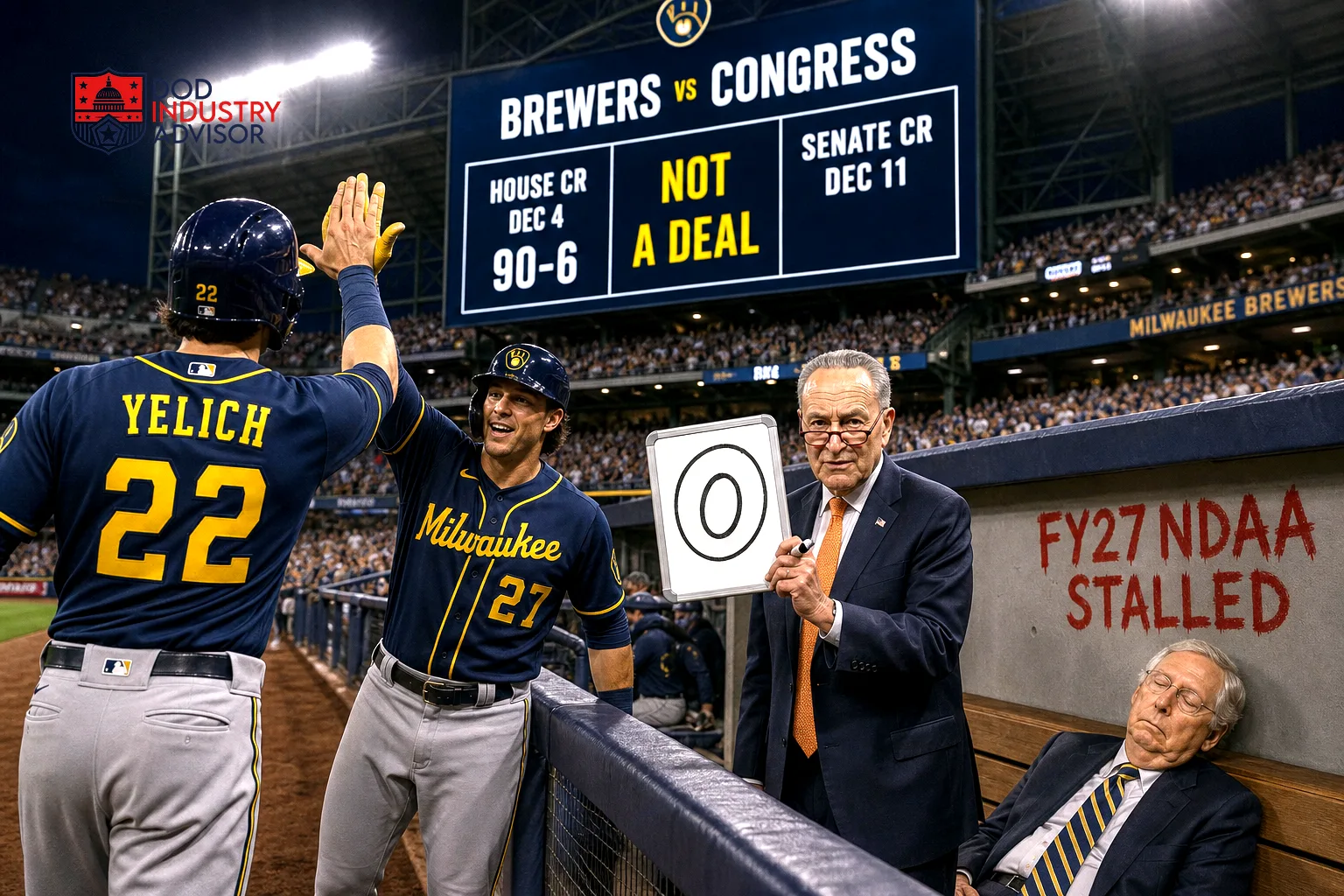
The Brewers opened the NL Central back to seven games. Congress opened nothing. Milwaukee is 81–49 after taking three of four from the Dodgers and the first two from Atlanta. The Cubs had made it look like a race. It was not. The Senate’s 90–6 stopgap, passed at 3:37 a.m. on August 8, looks the same way. It is one chamber’s version of a freeze through December 11, written onto H.R. 6500. The House already passed a different freeze, H.R. 9770, 220–205, that dies a week earlier. Neither bill is law. The FY27 NDAA is still parked after cloture failed 50–46 on July 14. The White House asked for $1 billion in early work on a battleship class CBO just priced at about $275 billion. The Senate kept it out. For a small firm that is not already on contract, recess is not a pause. It is the week the new-start window stays shut. While both chambers argued about a freeze, Treasury’s other scoreboard crossed $40 trillion.
A week ago the Cubs had the NL Central looking like a race. Milwaukee had just been swept in San Diego. Chicago had it under five games. Then the Brewers did the boring thing first-place clubs do when someone gets ideas. They took three of four from the Dodgers. They took the first two from Atlanta, including a 4–1 on Saturday. Randy Arozarena ended the Cubs’ Saturday with a walk-off in Seattle. Milwaukee woke up Sunday at 81–49, about seven up on the Cubs (74–56 as of Sunday morning standings), the largest lead since July 26. They play Atlanta tonight in the Little League Classic in Williamsport. No Sunday score in this issue. About five weeks left. The standings that matter stopped being close.
Washington had the inverse week. The Senate’s 90–6 at 3:37 in the morning looked like daylight. It was not. It was one lineup card. The House had already posted a different one, 220–205, a week shorter, with a different set of exceptions. Until those cards match, the government is still playing out the string on FY26 money. The defense bill that would authorize the next season is a scratched starter: cloture failed 50–46 on July 14, a motion to reconsider is sitting on the bench, and nobody brought it in from the bullpen during recess.
That is the useful frame. Milwaukee’s lead is real because both clubs played the same schedule. Congress’s “deal” is not real because the two chambers passed different bills. A blowout vote on unmatched text is still unmatched text.
The Standings
The week’s board. Milwaukee opened it. The Cubs got the walk-off taken from them. Congress still has two scorecards. The battleship did not even get an at-bat.
| Possession | Status | Score |
|---|---|---|
| Milwaukee Brewers | 81–49 through Saturday; about seven up on the Cubs | ▲ Daylight |
| Chicago Cubs | 74–56; Arozarena walk-off Saturday in Seattle | ▼ Fake race |
| Senate CR | H.R. 6500 as amended, 90–6 at 3:37 a.m. Aug 8, through Dec 11 | ▲ Passed Senate, not law |
| House CR | H.R. 9770, 220–205 on July 21, through Dec 4 | — Different card |
| FY27 NDAA | House 216–212 on July 22; Senate cloture failed 50–46 on July 14 | ▼ DNP — Coach’s Decision |
| Trump-class AP | $1 billion White House ask kept out of the Senate CR | ▼ Benched |
| Gross national debt | Treasury Debt to the Penny: crossed $40T on Aug 18 | ▲ The other scoreboard |
Two Stopgaps Is Not One
People keep saying Congress “passed a CR.” They did not. They passed two.
The House went first. On July 21 it passed H.R. 9770, the Continuing Appropriations Act, 2027, 220–205 (Roll no. 272), a near party-line extension of FY26 rates through December 4. NPR counted six Democrats in the yes column. The Senate received the bill the next day and declined to take it. Majority Leader John Thune had said he wanted a funding plan done before the August recess. He got one. It was not the House’s.
At 3:37 a.m. on August 8 the Senate passed H.R. 6500, as amended, 90–6, with Lindsey Graham voting present and three not voting. The vehicle’s original title still talks about African trade preferences. The text, as passed, is a continuing appropriations act through December 11. AP called the 90–6 a sign the chamber is still smarting from two shutdowns this past year. That is true, and it is not the point. A 90–6 on a Senate amendment does not move a dollar until the House passes the same words.
The differences are not cosmetic. The House bill ends December 4. The Senate bill ends December 11. The Senate text delays OMB’s rewrite of Uniform Guidance for federal grants through that same date, a Susan Collins priority. Sen. Patty Murray called the underlying rule an attempt to make tax dollars “work for Donald Trump.” Collins said she had never seen a proposed rule generate that many negative comments. Brownstein, working off the chairwoman’s section-by-section, also notes a congressional pay freeze for the duration of the CR. None of that is in a signed law. It is in a Senate amendment waiting on a House that is out until at least August 31, with the Senate itself gone until September 14.
In baseball this is two clubs posting different lineups for the same game and then leaving town. In appropriations it is called a conference, except one side will not be back until two weeks before the fiscal year starts.
The arithmetic of September is worse than the vote looks. Fiscal year 2027 starts October 1. The Senate calendar then shows another stretch around the midterms. A CR that runs into December is, among other things, a decision to finish FY27 appropriations after the election. For a contractor, that is not a vibe. It is the obligation calendar.
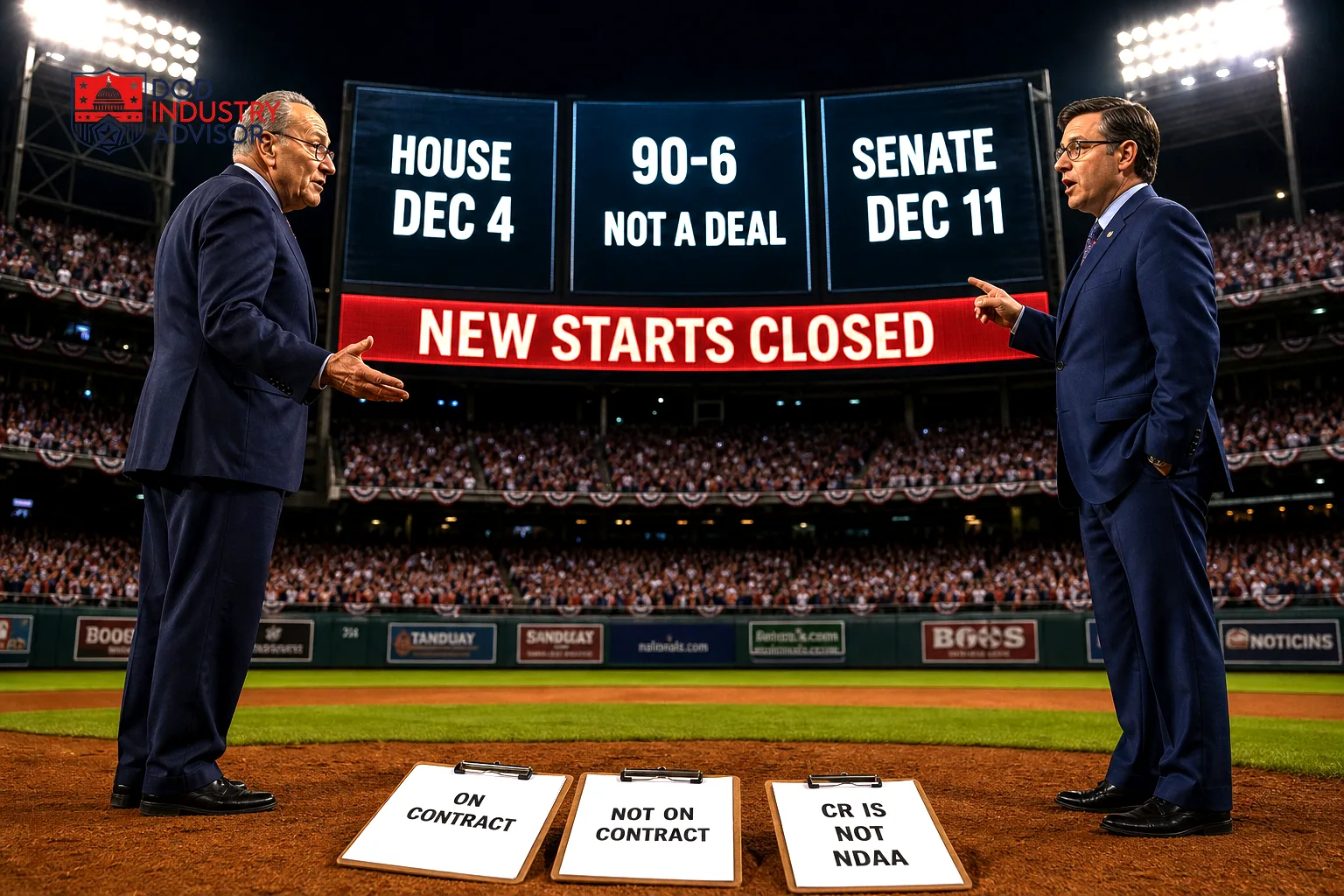
The Other Scoreboard
Call it what it is. The $40 trillion number that landed this week is not the deficit. It is the debt. The flow is still ugly. The stock just hit a round number.
Treasury’s Debt to the Penny series closed August 17 at $39.987 trillion. On August 18 it closed at $40.047 trillion. That is the first print over $40 trillion in the series. As of August 20 it was $40.033 trillion. The $39 trillion print was March 17. Five months to the next trillion. Reuters, the Washington Post, and the New York Times all wrote the milestone off that Treasury statement. The primary source is the Treasury file, not the headlines.
The annual hole is a different number. CBO’s February 2026 baseline put the FY2026 deficit at $1.9 trillion, 5.8 percent of GDP, against a 50-year average of 3.8 percent. The Bipartisan Policy Center, summarizing CBO’s July monthly review, says the agency has since raised the full-year estimate to $2.1 trillion, with $1.8 trillion already on the books through July. I have not opened that July PDF myself. Treat the $2.1 trillion as CBO-as-reported until we do.

Here is the joke the GOP does not want on a Sunday. This is a Republican White House, a Republican House, and a Republican Senate. The brand is fiscal conservatism. The product this week was a continuing resolution that freezes last year’s discretionary rates and a debt clock that just rolled over $40 trillion on their watch. A CR freeze is not a balanced budget. It is last year’s lineup, replayed, while interest on the principal keeps batting. The New York Times noted that the United States is on track to borrow more than $2 trillion this year, with interest now a large share of the red ink, and pointed at the 2025 tax cuts and war costs as part of the mix. The Post added that the milestone arrived earlier than expected in part because of lost tariff revenue after the Supreme Court knocked out authorities. That is journalism. The Treasury date is not.
The strongest counterargument is also the honest one. Most of that $40 trillion was not voted this month. It is Social Security, Medicare, Medicaid, net interest, and years of tax and spending choices by both parties. Reuters’ own headline said the debt doubled under Trump and Biden. A CR that bars new P-1 lines does not touch the mandatory side. If you pretend a stopgap is a debt ceiling, you are doing the same sloppy thing as calling the $40 trillion a deficit.
What would change the conclusion: a FY27 budget that actually reduces the deficit, or a debt-to-GDP path that turns down. A 90–6 freeze through December 11 does neither. For a contractor, the CR still decides whether your new start exists. The $40 trillion decides how crowded the interest line gets in the next NDAA fight. Those are two different games. Washington is playing the small one and calling it conservatism.
What a CR Actually Does to You
The strongest argument against this view is the one every Hill staffer will give you: CRs are how the Pentagon has lived for a generation. Existing contracts keep paying. Options get exercised. The NDAA, CRS notes, has been enacted on average 45 days after the fiscal year started since FY1977. A CR is not a shutdown. Incumbents already in the program of record will be fine.
Believe that. Then price the other half.
A CR at FY26 rates is continuity for work that already exists. It is a freeze for work that does not. Both bills say so in the same place. House H.R. 9770 and Senate-passed H.R. 6500, Sec. 102 and Sec. 104, bar new production of items not funded in FY2026, bar production-rate increases, bar new P-1 and R-1 lines, and bar initiating multi-year procurements with CR money. Breaking Defense had the same read. The GPO text is the source. The surprise is how many small firms treat “we avoided a shutdown” as “the new work is coming.” It is not.
This is the daylight problem in reverse. Milwaukee’s seven-game lead is the same schedule, counted twice. A CR is last year’s schedule, replayed. If you were already in the lineup, you keep your at-bats. If you were a September call-up — a first production lot, a new start, a multiyear that needed an anomaly — you are watching from the rail.
AP reported that Democrats blocked the White House’s request for $1 billion in early work on the Trump-class battleship. Chuck Schumer said the quiet part.
You can argue with the politics. You cannot argue with the scorekeeper. On August 5 the Congressional Budget Office estimated it would cost about $275 billion in 2026 dollars to build 15 of the nuclear-powered ships through 2056, with the first about $23 billion and the next fourteen averaging $18 billion. Under the 2027 shipbuilding plan, CBO said average annual surface-combatant funding would have to rise from about $11 billion to $19 billion, and by 2035 the tonnage shipbuilders would need to produce would more than double. That is not a press release. That is CBO telling you the industrial base cannot absorb a first-of-class battleship on CR money even if the politics were unanimous.
Breaking Defense reported the White House also wanted language to obligate five multiyear munitions contracts — PAC-3, Tomahawk, AMRAAM, and two SM-3 variants. Both CRs keep the Sec. 102(b) ban. Collins’s “shipbuilding across multiple vessels” is not that, and it is not the battleship. Senate Sec. 126 is prior-year shipbuilding cost-to-complete, with listed caps that sum to about $2.61 billion, on existing hulls. If you are a munitions supplier who was told the multiyear would save the rate, a CR without that anomaly is not a bridge. It is the rate going back to whatever FY26 allowed.
The Other Scratched Starter
The NDAA is the other locked door, and it is a different kind of scratch.
The House passed H.R. 8800 on July 22, 216–212. CRS records that the July 21 rule, H.Res. 1438, also folded the Safeguard American Voter Eligibility Act into the engrossed text sent to the Senate. That is not a side quest. It is one reason a defense authorization is now carrying election-administration freight into a midterm autumn. The Senate Armed Services Committee reported S. 4784 on June 15, 18–9 out of committee. Cloture on the motion to proceed failed 50–46 on July 14. Majority Leader Thune voted no so he could move to reconsider. Recess did not pick it up.
Authorization is not appropriations. For a small firm the sequence is still the same: no NDAA, no new policy, no new starts hiding in report language, and a conference that now has to share September with two unmatched CRs and twelve unfinished appropriations bills. House Appropriations has moved all twelve bills through committee. Only three have passed the floor. The Defense bill, H.R. 9495, cleared committee 34–27 and has not seen the House floor. Brownstein’s August 8 client note is the box score: the Senate Appropriations Committee has not released legislative text for any of the twelve.
CRS also keeps the long memory. Since FY1977, defense authorization has been enacted, on average, 45 days after the fiscal year started. Late NDAAs are not a crisis. They are the sport. What is not the sport is pretending a failed cloture vote plus a CR without new-start authority is a capture plan for anyone whose work begins on October 2.
Last week’s issue treated the stopgap as if the House and Senate had passed the same thing. They had not. Continuity requires saying so.
The Monday Move
Before your BD lead leaves for Labor Day, write down the exact FY27 action you need in October: a new start, an option, a multiyear increment, a first article. Then ask the program office, in writing, whether a CR at FY26 rates lets them sign it. If the answer is “we need an anomaly” or “that’s in the NDAA,” you do not have a Q1 plan. You have a hope.
If your answer is “contracts has it,” you do not have an answer.
What Changed Since Last Week
Last issue treated the stopgap as done. The Senate vote was real. The conference is not. Two bills, two end dates, no signature. Recess did not move the NDAA. Cloture is still failed, 50–46. The CBO battleship report, published August 5, is the industrial-base document the CR vote talked past. The Brewers, who last week were a power-rankings headline, spent this week turning a fake race into daylight.

What This Means for You
If you are already on contract: keep performing. A CR is not a stop-work. The catch is option years and increments that look like new work to a comptroller. Before you staff October, get the contracting officer to say in writing that the next action is a continuation under FY26 rates, not a new start.
If you are waiting on a first award, a first production lot, or a multiyear that needed an anomaly: do not staff to an October start. Breaking Defense reported the Senate text would forbid new program starts and that the five multiyear munitions anomalies did not travel. Staff to identical text signed into law, then read the anomalies. If your rate depended on the multiyear, model the FY26 rate until someone shows you the clause.
If you sell to a program office that was waiting on the NDAA: H.R. 8800 is a House-passed bill with SAVE America Act election language bolted on. S. 4784 has not been taken up. Cloture failed 50–46. Report language you were quoting in a white paper is not law. Rebuild the Hill packet around what is actually in the House-passed text, not around the chairman’s mark from June.
If you live on grants or grant-flowdown: the Senate CR’s Uniform Guidance delay is a Collins–Murray item. It dies if the House refuses it. Do not rebuild your compliance shop on a Senate amendment. Price the rule as live until the House takes the Senate text or they write a third bill.
If you sell “the GOP will be the fiscal adults” as a capture story: Treasury crossed $40 trillion on August 18. A CR freeze is not a paydown. Price programs against interest crowding the discretionary top line, not against a brand.
Question of the Week
What is the one October action your firm was counting on that a CR at FY26 rates cannot support?
A) A new start / first award
B) An unexercised option the comptroller may call new work
C) A multiyear increment that needed an anomaly
D) Nothing. We are on contract and we will be fine
E) We do not know, which is the actual problem
The smart money is on E until someone asks the contracting officer. Best answer runs next week, anonymous if needed.
The Cubs made it look close. Then Milwaukee counted the same games twice. Congress posted two different lineup cards and left town. Treasury posted $40 trillion. Daylight is a lead. A freeze is not a paydown. It is not a deal.
Source presentation is carried in the article body where applicable. Reported facts and analytic judgment are kept distinct.